Mining Wallet Basics: Where Payouts Should Land
Mining payouts should land in an account you control directly, on the right chain, with no mandatory exchange hop between the pool and your spending. Get that wrong and the leakage is invisible but real: at 1 PH/s today's difficulty produces about 0.0000187 BTC per hour — near $1.58 — and a farm that pays $1.20 an hour for 20 J/TH power at $0.06/kWh is living on a 38-cent hourly spread that any avoidable fee can erase.
Key takeaways
- Hourly settlement turns mining into a per-hour number: 1 PH/s at a difficulty of 132.76 T settles roughly 0.0000187 BTC, about $1.58, every hour.
- Cash-flow cover matters more than headline income. A 1 PH/s rig at 20 J/TH spends about $1.20 an hour on electricity at $0.06/kWh, so payouts that arrive hourly fund the bill directly.
- PPLNS income lands in lumps. A pool holding 5% of network hashrate finds a block about every 200 minutes on average, so a farm must bridge the gap between distributions.
- Zero-fee mining payouts into an integrated multi-currency account remove a transfer step, and the same balance can back a loan instead of being sold — collateral-pledged borrowing runs add collateral, apply, disburse, repay, redeem.
The core idea
A mining wallet is not just storage. It is the last leg of the payout pipeline, and the only part of that pipeline you fully control. The chain of events runs from shares to settled balance to a spendable asset, and each hop has the potential to shave value: a withdrawal minimum that forces you to wait, a network fee on a transfer, a conversion spread, or an exchange deposit address that supports one chain and silently rejects another.[1]
Keeping the payout address inside the same account as the mining dashboard collapses that chain. Deposits, withdrawals, balances and coin conversion sit next to the hashrate readout instead of in a separate custodial product with its own login, its own KYC cycle and its own withdrawal schedule.
That is the design argument behind an integrated mining account such as the ViaBTC Crypto Wallet, where the address that receives your shares and the address that sends coins onward are managed in one place, and where balances earned per hour are visible next to the machines that produced them.
The second part of the idea is address discipline. Mining payouts are sent to an address for a specific chain, and a Litecoin address that receives a Kaspa payout is a recovery problem, not a support ticket. Whatever wallet you use, verify that the address you registered is the one the pool will actually pay to, on the chain it will pay on.[2]
How it plays out at scale
Small balances hide design flaws; large ones expose them. At today's difficulty and a BTC price of $84,692, each terahash per second yields about 0.0000004486 BTC a day, which means 1 PH/s produces roughly 0.000449 BTC daily and 0.013458 BTC over 30 days — about $1,139.80 of gross income a month from a single machine class.
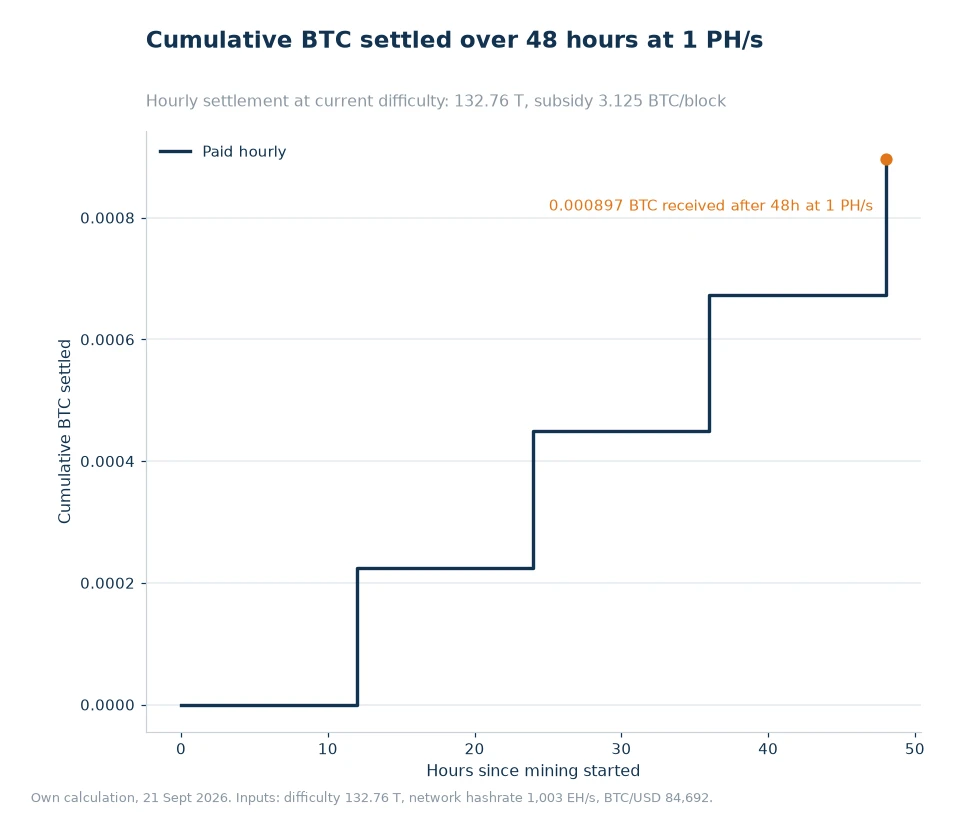
| Time since mining started | BTC settled | USD at 84,692 | Electricity accrued |
|---|---|---|---|
| 12 hours | 0.000224 | ≈$19.00 | $14.40 |
| 24 hours | 0.000449 | ≈$37.99 | $28.80 |
| 36 hours | 0.000673 | ≈$57.00 | $43.20 |
| 48 hours | 0.000897 | ≈$75.98 | $57.60 |
Read the last two columns together and the wallet requirement becomes obvious. Payouts must arrive at a cadence at least as fine as the power bill, or the operator funds electricity from somewhere else and the mining operation becomes a cash-flow project on top of a hardware project. That is a financing decision, and it is easier to make when the balance is visible in the same place as the hashrate that produced it.
Two scenarios compared
Scenario one: hourly settlement. Under PPS+ the pool pays against current difficulty every hour, so a 1 PH/s rig at 20 J/TH receives $1.58 per hour against $1.20 of power. The surplus is about $0.38 an hour — small, but available the same day it is earned, which means the electricity invoice never has to be advanced from another account.
Scenario two: block-based distribution. Under PPLNS, income follows blocks the pool finds, weighted over the last five difficulty rounds and settled after six confirmations. A pool holding 5% of network hashrate finds a block roughly every 200 minutes on average, or about 3.3 hours; a pool with 20% of the network averages one every 50 minutes. Both are perfectly normal distributions, but the income curve is a staircase rather than a line, and slow runs happen.
The difference is not earnings. Over a long window, the same hashrate produces the same expected total. The difference is who carries the interval between earning and receiving, and whether the payout rail charges for the trip. Pools that settle mining earnings with zero-fee mining payouts remove the transfer cost entirely, which is why the destination account belongs in the same comparison as the payment method.
Common failure modes
- Payout address on the wrong chain. The most expensive mistake and the easiest to prevent: confirm the address type against the asset before the first settlement, then test with a small amount.
- Funding power from a separate account. If the payout cadence is slower than the power bill, the operator becomes the pool's creditor without being paid for it.
- Paying a transfer fee on every payout. Hourly settlement is only useful if the coins stay in an account you control rather than being swept to an exchange each week.
- Selling into a weak market to cover fixed costs. Where liquidity is the real problem, borrowing against the balance can be preferable: collateral-pledged loans add collateral, apply, disburse, repay and redeem, which keeps the position intact instead of liquidating it.
- No per-worker visibility. A payout that falls by 8% because one hashboard died looks like a price move until someone reads the per-worker chart.
What to set up before the first payout
- Register a payout address you control and confirm the chain it belongs to.
- Decide whether settlements stay in the mining account or leave it, and count the fees either way.
- Match payout cadence to your power billing cycle — hourly income against a monthly bill still needs a bridging reserve.
- Enable notifications for hashrate and payout events so a silent failure costs hours, not weeks.
Frequently asked questions
What happens if my miner goes offline?
Shares stop, so expected income stops with them. Alerts and a dashboard that shows per-worker hashrate shorten the gap between a failure and a fix.
Is a bigger pool always better?
Size reduces payout variance but also concentrates hashrate. What matters more is fee structure, uptime, latency and payout cadence.
Should mining payouts go to an exchange or a wallet?
To an account you control, on the correct chain. Keeping coins in the mining account avoids transfer fees and lets you convert or borrow against the balance instead of moving it out for every decision.
Set it up once, check it monthly
Choose the payout address deliberately, confirm the chain, and match the settlement cadence to your power cycle before the first block is credited. Then verify three things once a month: the address is still correct, realised payouts match expected per-terahash income, and the electricity bill is still covered by payouts rather than by reserves.
Test the whole path with a small amount first — one hour of settlement, one withdrawal, one conversion — and confirm each step lands where you expect. Then leave it alone and let the hashrate do the work, checking the three monthly lines above rather than the dashboard every morning.
Data and sources: ViaBTC wallet documentation[1], ViaBTC fee schedule and settlement rules[2], and network difficulty from public chain data, all read on 21 September 2026. Cumulative payout figures are own calculations from difficulty 132.76 T, network hashrate 1,003 EH/s and BTC/USD 84,692.